

By: Steadman Boston, Ed.D

Hazing is far from new. As far back as Ancient Rome and Ancient Greece, ritual probing of the human strength and loyalty has had a long-standing presence in the identity and initiation of the group (Bruckner, 2018). On college campuses today, the term “hazing” immediately conjures the world of the fraternities and sororities, but the range extends far beyond the realm of the Greek system. Sports teams, clubs, and other student organizations haven’t remained unaffected. Hazing by its very definition is typically the method by which people are coaxed, pushed, or pressured into doing something that causes physical, emotional, or psychological harm (Jeckell et al., 2018). The trauma doesn’t end when the behavior takes place; research shows the impacts can be felt throughout the entire span of one’s life, both personally and professionally. Research shows that more than 50 people have died in hazing-related incidents since the year 2000 (Kesslen, 2021).
As pervasive as it remains, hazing prevention continues to be a stubborn issue. The typical remedies, such as zero-tolerance policies and harsh sanctions—well-intended as they are, far too frequently push hazing into even more secrecy (Parks, 2021). Scholars reaffirm that significant change means something more than a penalty. It requires strong organizational leadership, engaged alumni, sustained responsibility, and interdisciplinary roots in psychology, sociology, and education.

Historic Act: The Stop Campus Hazing Act
In December 2024, the battle against hazing achieved a historic national landmark. President Biden signed the Stop Campus Hazing Act into law after it had been unanimously approved by both the House and Senate. The Act constitutes one of the most extensive federal movements devoted to eradicating hazing.
The statute mandates colleges and universities to:
- Report hazing incidents in their annual security reports
- Release hazing transparency reports on the internet
- Implement research-informed prevention programs
By establishing a uniform definition of hazing and ensuring that prevention measures are in the public domain, the measure supports accountability and allows students and families to make decisions about campus life based on better information.
SAE’s Prevention and Educational Role
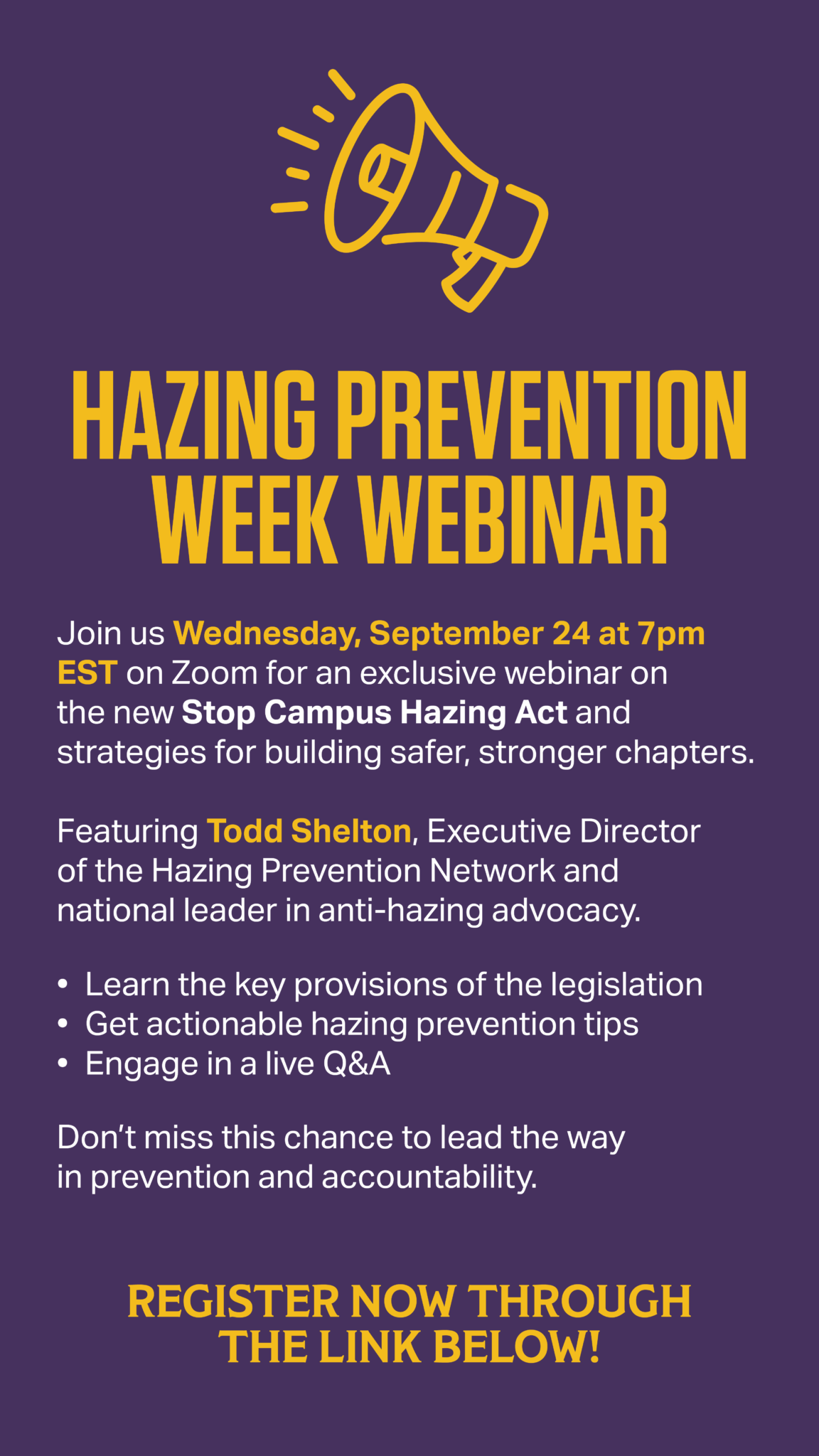
Approaching Hazing Prevention Week, the Sigma Alpha Epsilon Fraternity proudly joins in the endeavor to support the Stop Campus Hazing Act. The Fraternity Service Center will be conducting a webinar on the Stop Campus Hazing Act online on the 24th of September 2025 at 7:00 PM EST through Zoom.
This dynamic program will:
- Cover key provisions of the statute
- Explore how it impacts student organizations and higher education
- Offer real-world techniques for chapter leaders to be in compliance while creating a safe and healthy brotherhood
Not only will the participants better understand the law, but they will also take home practical preventative advice that can be used at the immediate campus and chapter level. The option to personally engage the experts will be available through a live question-and-answer feature.

Hazing Prevention Webinar Facilitator: Todd Shelton
The webinar will be led by Todd Shelton, the executive director of the Hazing Prevention Network. As a nonprofit leader for more than two decades, Shelton is a major advocate in the United States for the anti-hazing movement. Shelton is one of the contributing leaders in the Anti-Hazing Coalition and the former Chief Communication Officer at the North American Interfraternity Conference, at which institution Shelton established industry-wide response protocols and elevated the public perception of fraternity. His experience—gained through decades of advocacy, education, and leadership within organizations—has the potential to provide SAE members with a more nuanced understanding of the challenges and the opportunities in preventing hazing.

Answering the Call
The health, safety, and well-being of our members must always be paramount. When it comes to Sigma Alpha Epsilon, hazing has no place in a brotherhood built upon the values of the True Gentleman. The Stop Campus Hazing Act provides good resources, but legislation alone cannot get the job done. It’s all of us— undergraduates, alumni, and national leaders— who must embody the values of our Ritual, lead by example ourselves, and establish a culture in which brotherhood thrives and not at the expense of safety.
This September, will you answer? Become part of the movement to stop hazing by clicking here to register.
Citations:
Bruckner, H. (2018). Students Fall Victim to Hazing Epidemic: Unity at What Cost? Touro Law Review, 34(2), 459–493. https://eds.s.ebscohost.com/eds/detail/detail?vid=4&sid=2118bdf1-a775-4dcc-9ffa-10105dbe5c3e%40redis&bdata=JkF1dGhUeXBlPXNzbyZzaXRlPWVkcy1saXZlJnNjb3BlPXNpdGU%3d#AN=132554504&db=ofs
Jeckell, A. S., Copenhaver, E. A., & Diamond, A. B. (2018). The spectrum of hazing and peer sexual abuse in sports: A Current perspective. Sports Health a Multidisciplinary Approach, 10(6), 558–564. https://doi.org/10.1177/1941738118797322
Kesslen, B. (2021, March 13). Family of college student found dead at off-campus party speaks out [Video]. NBC News. https://www.nbcnews.com/news/us-news/if-student-deaths-won-t-stop-fraternity-hazing-what-will-n1260750
Parks, G. S. (2021a). PLEDGE TO END HAZING. In WAKE FOREST LAW REVIEW ONLINE (Vol. 11, pp. 111–113). https://www.wakeforestlawreview.com/wp-content/uploads/2021/09/11WakeForestLRevOnline111.pdf